

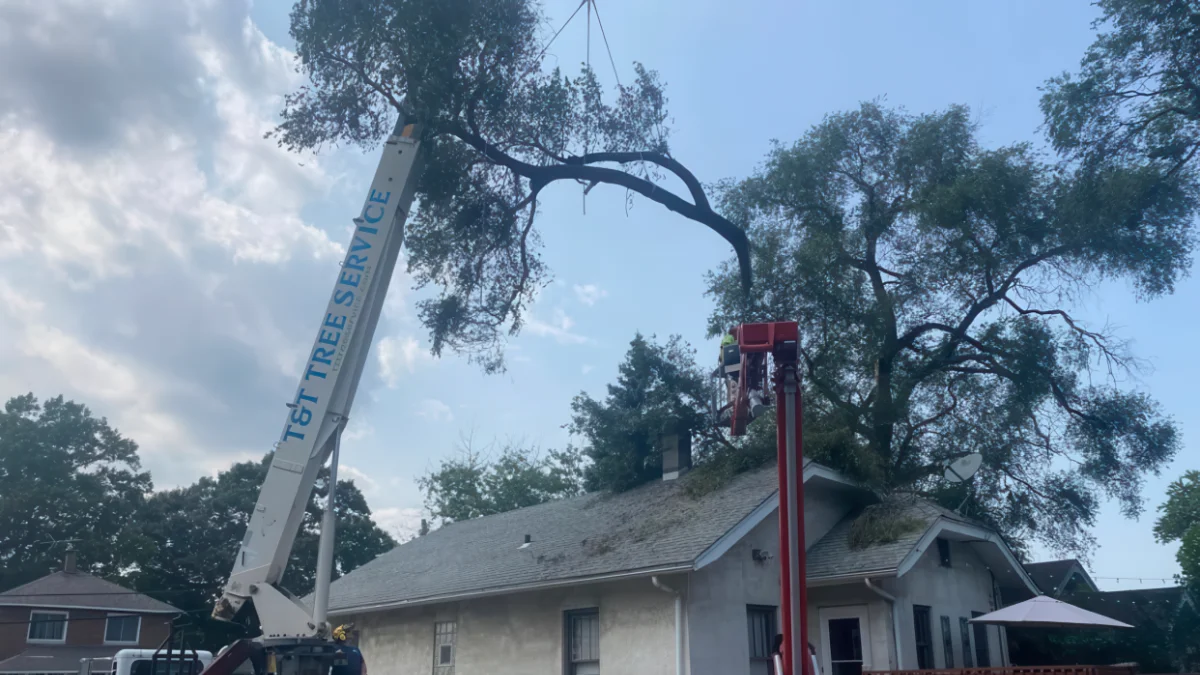
Most homeowners don’t give much thought to the tree branch hanging over their roof. It’s been there for years, nothing bad has happened, and it’s easy to assume it’ll stay that way. But overhanging tree branches are one of the most common causes of roof damage in Northwest Indiana, and the longer they’re left unaddressed, the more risk they create for your home.
When Overhanging Branches Are a Minor Nuisance
Not every branch that extends toward your house is a five-alarm emergency. Small branches with plenty of clearance, meaning they don’t actually touch the roof and stay well above the surface, are generally lower risk. If the branch is healthy, actively growing, and not directly positioned over the peak of your roof, you’ve got a little more breathing room.
That said, “minor” doesn’t mean “ignore it.” Even a small overhang can become a problem after a heavy storm rolls through Porter County. Here in Northwest Indiana, weather can shift fast, and a branch that looks perfectly fine in July might be a real hazard by the time an August thunderstorm hits.
The smart move is to monitor smaller overhangs regularly, especially heading into storm season. And if you’re ever unsure whether what you’re looking at is truly harmless, a quick professional check is worth it. It’s a lot cheaper than a roofing repair.
When Overhanging Tree Branches Become a Real Problem
This is where things get serious. A tree branch hanging over your roof becomes a real problem under several specific conditions, and it’s important to know what to look for.
First, branches that are actually touching or rubbing against your roof. Every time the wind blows, that branch is grinding against your shingles. It wears down the protective granule layer over time, and that creates openings for water to get in. (Think of it like sandpaper working slowly against your roof every single day.)
Dead or dying branches are a separate and more urgent concern. A dead branch doesn’t need a major storm to fall. It can come down on a calm day with just a little wind, and if it’s positioned over your roof, the damage can be significant. Large branches over the roof, even healthy ones, carry serious weight. And branches that hang near or over power lines create a safety hazard that goes well beyond roof damage.
The Storm Risk in Northwest Indiana
Northwest Indiana gets hit hard by weather. Summer thunderstorms bring high winds and lightning. Winter ice storms add serious weight to branches that were already under stress. Spring thaw can weaken root systems and destabilize whole trees. A branch that seems perfectly stable on a sunny afternoon can turn into a projectile when straight-line winds push through the region.
Indiana has seen significant storm damage in recent years, and the NWI area is no exception. Fallen branches and downed trees are a common call for emergency services every storm season. That’s why proactive trimming before storm season hits is always the smarter and more affordable option compared to emergency removal after the fact.
T&T Tree Service offers 24/7 emergency tree removal throughout Northwest Indiana and the entire state of Indiana. But the goal is always to help homeowners stay ahead of problems before they become emergencies. If you’ve got a branch over your roof right now, getting it assessed before the next round of storms is the right call. You can learn more about T&T Tree Service’s emergency tree removal services for Northwest Indiana homeowners and get a clear picture of your options.
What Overhanging Branches Do to Your Roof Over Time
Even if a branch never falls, it can still do real damage. Shingle abrasion is one of the most common and least visible problems. Branches rubbing against the roof surface slowly wear away the protective granule layer on your shingles. Once that layer is gone, your shingles are far more vulnerable to UV damage, moisture, and cracking.
Moisture retention is another big issue. Leaves, twigs, and debris that collect on your roof don’t dry out the way you’d expect. They trap moisture against the roofing material, and over time that moisture leads to rot, mold growth, and deterioration that can work its way into your home. Northwest Indiana winters make this worse, because debris-covered roof sections can hold ice and snow longer than the rest of the roof.
Pest access is something homeowners often don’t think about until it’s too late. Squirrels, raccoons, and other animals treat overhanging branches like a highway straight to your attic. Once they’re up there, the damage they cause can be extensive. Clogged gutters, pulled fascia boards, and in the worst cases, full structural damage from a falling branch or tree, round out the list of reasons why overhanging branches deserve serious attention.
How to Tell If a Branch Is Dead or Dying
Knowing what to look for can help you catch a problem before it becomes an emergency. The most obvious sign is a lack of leaves during the growing season. If a branch on your tree isn’t leafing out when everything else is green, that’s a red flag. Leaves that come in brown, wilted, or sparse when the rest of the tree looks healthy are also a sign something is wrong.
Look at the bark. Bark that is cracking, peeling away, or falling off in chunks is a sign of a branch in serious decline. Visible fungal growth, like mushrooms or flat shelf-like growths called conks, on the branch itself or at the base of the tree is a major warning sign. Those fungi break down wood from the inside out, and a branch that looks solid from the outside may be hollow and brittle beneath the surface.
Check where the branch meets the trunk. Cracks or splits at that junction point are a sign the branch may be structurally compromised. And if a branch is brittle enough to snap easily when you bend a small section of it, the larger portion is likely in similar shape. When in doubt, don’t try to make the call yourself. A professional assessment from a qualified tree service is the safest and most reliable option.
What to Do About Overhanging Branches
Small branches under about two inches in diameter can sometimes be handled by a homeowner who has the right tools and takes proper safety precautions. But that’s a limited category. Larger branches, dead branches, or any branch that sits directly over your roof should be handled by a professional tree service. The risks of an improper cut, or a branch falling in the wrong direction, are too high to take on without the right training and equipment.
Never attempt to remove a branch that is near or over power lines yourself. That’s a job that requires coordination with the utility company and trained professionals. It’s not worth the risk. T&T Tree Service specializes in safely trimming and removing branches near homes, garages, sheds, and other structures throughout Valparaiso and the surrounding areas.
Getting a professional set of eyes on the situation is easy. T&T Tree Service’s free onsite quote for tree trimming and branch removal in Porter County means there’s no cost to find out exactly what you’re dealing with. Video quote requests can also be submitted online if you want to start the process before scheduling an onsite visit.
Why Professional Tree Trimming Matters
There’s a right way and a wrong way to trim a tree, and the difference matters more than most people realize. Improper cuts, the kind that leave stubs or tear the bark, create open wounds on the tree that invite disease and pest infestation. A poorly trimmed tree can decline quickly, which creates a bigger problem down the road than the overhanging branch you started with.
Working at height near a roof is also genuinely dangerous. Without proper equipment, training, and safety protocols, the risk of injury or property damage is real. That’s why it’s not just about convenience when you hire a professional. It’s about doing the job safely and correctly.
T&T Tree Service is licensed, bonded, and insured, which means your property is protected throughout the entire job. Their Google Guaranteed status reflects the kind of rigorous reliability standards that give homeowners real peace of mind. And when the job is done, they clean up completely. Every piece of debris is hauled away, and the property is left tidy. No mess left behind. You can review T&T Tree Service’s professional tree trimming services in Valparaiso and Northwest Indiana to get a full picture of what they offer and how they work.
Frequently Asked Questions
How do I know if a tree branch hanging over my roof is actually dangerous?
The key factors are the size of the branch, its condition, and how close it is to your roof. A large branch, especially one that’s dead or dying, is a serious risk even without a storm. Branches that are touching the roof or positioned directly above it are also cause for concern. T&T Tree Service serves homeowners throughout Valparaiso and Northwest Indiana and can assess your specific situation with a free onsite quote. Don’t rely on guesswork when a professional opinion is available and affordable. Getting eyes on the problem is always the right first step.
When should I call a professional tree service instead of handling the branch myself?
If the branch is larger than two inches in diameter, dead, or directly over your roof, call a professional. Any branch near power lines is an automatic call for a pro, no exceptions. T&T Tree Service handles branch trimming and removal throughout Northwest Indiana with the proper equipment and training to do it safely. Attempting to remove a large or dead branch yourself creates real risk of injury and property damage. The team at T&T Tree Service in Valparaiso can assess, quote, and complete the job with your safety and your property’s condition as the top priority.
How does Northwest Indiana’s weather make overhanging branches more dangerous?
NWI gets a tough combination of summer thunderstorms, high winds, and winter ice storms that put serious stress on trees and branches. Ice accumulation alone can add hundreds of pounds of weight to a branch that was already overhanging your roof. T&T Tree Service responds to storm damage calls throughout Northwest Indiana and has seen firsthand how quickly a “harmless” branch becomes a serious problem after a storm. Proactive trimming before storm season is always the smarter and more cost-effective approach. T&T Tree Service offers 24/7 emergency response, but their goal is always to help Valparaiso and NWI homeowners stay ahead of storm risk before it happens.
What kind of long-term damage can overhanging branches cause to my roof?
Overhanging branches cause damage in several ways even when they don’t fall. Constant rubbing wears down the protective granule layer on shingles. Debris accumulation traps moisture and accelerates rot and mold growth. And branches give squirrels and raccoons a direct path to your attic. T&T Tree Service works with homeowners across Porter County and Northwest Indiana to address these issues before they turn into expensive repairs. Catching the problem early with a professional trimming service is significantly less costly than dealing with roof damage, gutter repairs, or a pest infestation later.
What does T&T Tree Service’s branch trimming process look like for a typical job?
T&T Tree Service starts with a free onsite assessment to evaluate the branches in question and identify the safest, most effective approach. The crew uses top-of-the-line equipment to make clean, proper cuts that protect the health of your tree while eliminating the risk to your roof. Every job in Valparaiso and across Northwest Indiana ends with a full cleanup. Debris is hauled away and the property is left clean. T&T Tree Service is licensed, bonded, insured, and Google Guaranteed, so homeowners can feel confident from the first call to the final cleanup. Video quote requests are also available online for added convenience.
Tree Branch Hanging Over Your Roof in Northwest Indiana? Call T&T Tree Service.
T&T Tree Service is a licensed, bonded, and insured, Google Guaranteed tree service based in Valparaiso, IN. Father and son owned and operated. 5-star reviews. Free onsite quotes. Serving Valparaiso, Portage, Chesterton, Hobart, Kouts, Winfield, and all of Northwest Indiana. Visit tttreeservice.com for a free estimate.